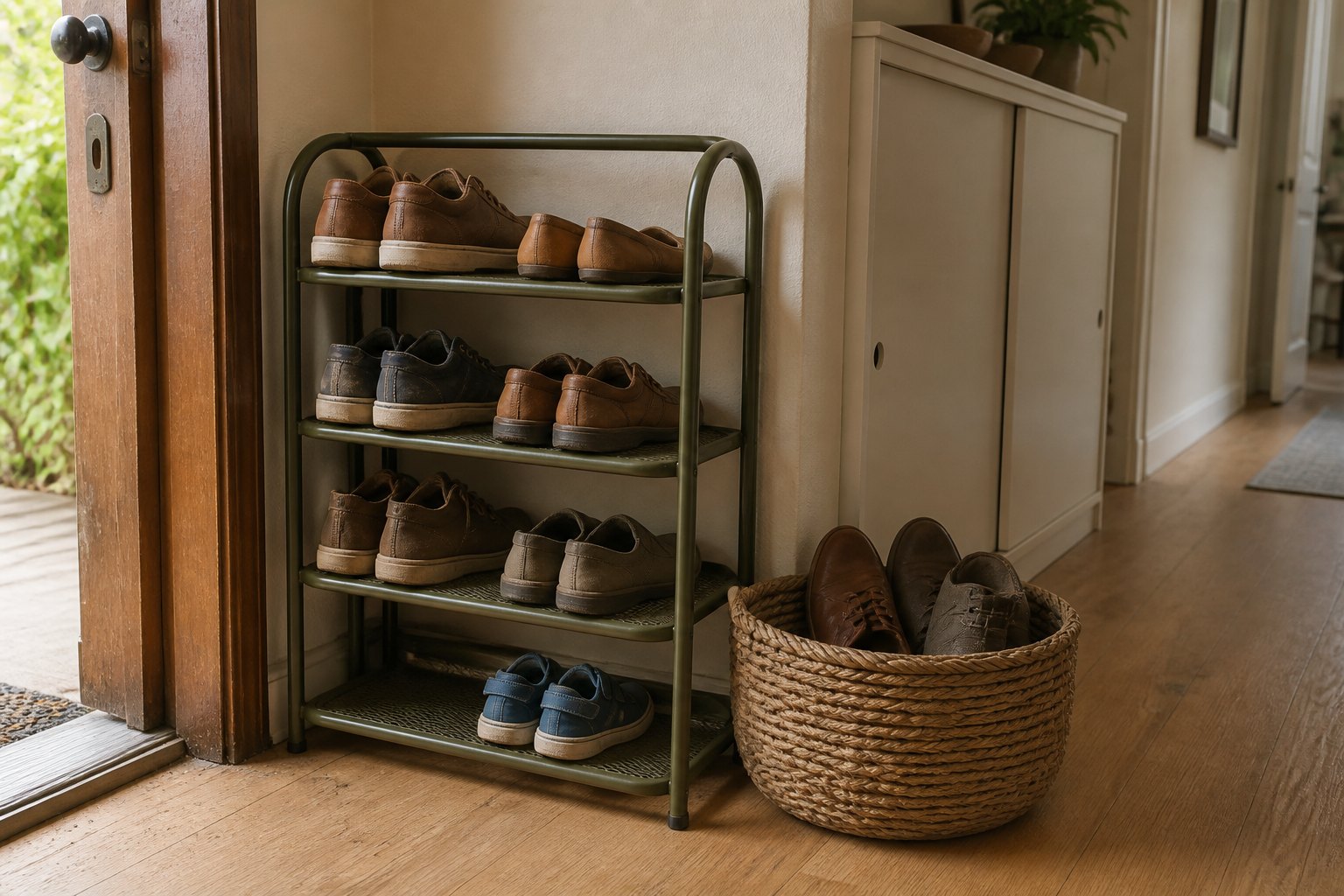
A small entryway does not fail because it lacks furniture. It fails when the only path through the door is also the only place left for shoes.
This guide is for choosing a storage format: open rack, closed cabinet, basket, or a bench with a shelf. The shoe-free landing-zone guide covers the whole doorway. Here the question is narrower: where do everyday pairs live when the hall is already tight?
Short answer
Count the pairs that must stay by the door, then measure the rectangle you can actually spare—width, depth, and door swing. Choose the simplest format that fits that rectangle and that the shortest person in the house can use.
- Open rack when shoes need to dry, children need to see their pairs, and you can live with a visible row.
- Closed cabinet when you want the visual pile gone and you can wall-anchor the unit.
- Basket when you have almost no depth and only a few dry pairs.
- Bench with a shelf when people need to sit down more than they need high capacity.
Wet boots still need a tray. Storage that hides wet shoes just moves the mess into a box. See mats and boot trays for that half of the system.
Decision criteria
Work through these in order. The first constraint that fails usually decides the format.
- Pair count at the door, not in the house. Everyday school, work, and one wet-weather pair per person is enough. Extra sneakers belong in a closet.
- Floor footprint. Measure the landing with the door open. The researched hallway units in this article are about 13 to 14 inches deep; if you cannot spare that, use a basket or a single row against the wall.
- Door clearance. Storage cannot sit in the swing of the front door or a closet door. Sliding cabinet doors help. A bench that blocks the door does not.
- Ventilation. Wet or snowy shoes need air. Closed cabinets are for dry pairs.
- Cleaning access. You will need to reach the floor under or behind the unit. Open legs and a pull-out tray beat a solid plinth.
- Child reach. If children cannot put shoes away without help, the pile will return.
- Anchoring. Tall or stackable units may need wall fasteners suited to your wall. If you cannot anchor, do not choose a tip-prone cabinet.
- Seating. If anyone in the household should not hop on one foot, a seat is part of storage, not a luxury.
Open versus closed
Open rack. Helps when shoes need to dry, children need to see their pairs, and you can wipe under the unit. Costs you a visible row and a drip line to the floor.
Closed cabinet. Helps when you want shoes out of sight in a narrow hall. Costs you moisture if wet pairs go in, extra assembly, and required wall anchoring.
Basket. Helps when depth is tiny and pairs are few and dry. Costs you slumped shoes and no drying path for mud.
Bench and shelf. Helps when people need to sit to change shoes. Costs you low pair count, and dirt can fall through an open shelf.
No format is a ranking. A basket that gets used is doing more work than a cabinet that never gets anchored.
Floor footprint and door swing
Tape the footprint on the floor before you assemble anything.
- Width: the researched rack, cabinet, and bench are each about 31 inches. Two units side by side is a mudroom, not a small entry.
- Depth: 12 to 14 inches is already a lot in a galley hall. Add the space a person needs to stand in front of it.
- Height: a low rack stays out of sight lines and is easier to wall-pass. A 40-inch cabinet stores more and becomes furniture you have to live with.
- Swing: stand where the door is fully open. If your heel would hit the unit, it is in the wrong place.
If the front door opens in and eats the landing, put storage on the hinge wall or move everyday shoes to the nearest closet and keep only a tray at the door.
Child access
Open, low, and obvious wins. A closed sliding door adds a step. A high shelf trains children to drop shoes on the floor “for later.”
A useful child setup is one open shelf or one basket that holds only their everyday pairs, plus a hook they can reach. Adult pairs can live higher or elsewhere. The guest guide is about visitors; this is about the people who use the door four times a day.
Assembly and wall anchoring
Treat manufacturer warnings as part of the product, not fine print.
- An open steel rack may be stackable only if both units are anchored.
- A tall cabinet with a tipping warning must be anchored with fasteners that match the wall. If you are unsure, get help before you fill it with shoes.
- Anchoring is harder on plaster, tile, or a rented wall you cannot drill. In those rooms, choose a low, heavy-enough rack you will not stack, or a basket.
Skip any unit you cannot assemble and install as directed. A half-built cabinet in a walkway is worse than a pile.
Cleaning access
Assume grit will get under the storage. The easier path is:
- legs or an open base you can reach with a vacuum
- a tray you can pull out
- no sealed kickplate against the floor
Closed cabinets hide the shoes and also hide the spill. If you choose one, leave wet pairs on a tray outside it until they are dry.
Who should choose each format
Open rack. Households with a few everyday pairs, kids who need to see their shoes, and a hall that can stand a visible row. Good when shoes come in damp and need air.
Closed cabinet. Households that care more about a clear visual field than about one-step access, and that can anchor the unit. Better for dry pairs in a space that also has to look finished.
Basket. Apartments, temporary setups, or a second door that only needs two or three dry pairs. Pair it with a tray for wet days.
Bench with a shelf. Households that need a seat more than they need sixteen pairs at the door—older kids putting on their own shoes, guests, anyone who is safer sitting down. Capacity will be small.
Who should skip each format
- Skip an open rack if drips would land on a finish you cannot wipe, or if a visible row will bother you enough that you stop using it.
- Skip a closed cabinet if you cannot anchor it, if boots come in wet, or if large shoes will not fit the shelf depth without awkward angles.
- Skip a basket if you are storing more than a handful of pairs or anything muddy.
- Skip a bench if you need high capacity, if the seat height or load rating does not match the people who will sit, or if a bench would block the door.
Three researched examples
These are official-spec examples for the formats above. They are not a ranked list, not household tests, and not affiliate links. A sturdy crate, a low stool, and a closet shelf can cover the same jobs.
Open rack. IKEA’s MACKAPÄR shoe rack is a powder-coated steel unit about 30 3/4 by 12 5/8 by 15 3/4 inches. The page says it holds about six pairs, is indoor-only, and can be stacked if both racks are wall-anchored. The main drawback is the open drip line and the modest shelf height for tall boots.
IKEA MACKAPÄR shoe rack at IKEA · ResearchedSkip it for outdoor or damp rooms, or if you cannot anchor a stacked pair. A single low rack you do not stack is the simpler version.
Closed cabinet. The MACKAPÄR shoe cabinet is about 31 1/2 by 13 3/4 by 40 1/8 inches, with sliding doors and shelves that can sit flat or angled. IKEA lists about sixteen pairs and a tipping-hazard warning that requires secure anchoring. Closed storage will not dry wet boots, and larger shoes may need the angled setting.
IKEA MACKAPÄR shoe cabinet at IKEA · ResearchedSkip it if you cannot fasten it to the wall. A low open rack plus a curtain is a less rigid way to hide shoes.
Bench and shelf. IKEA’s NIPÅSEN bench is about 31 1/8 by 13 3/4 by 20 1/2 inches, with a stretched-metal shelf for about four pairs and a listed 220.5-pound seat test. Dirt can fall through the shelf; IKEA notes a 28-by-13 3/4-inch BAGGMUCK tray can sit underneath (the approved 28-by-14-inch tray is that size). This is a seat with a little storage, not a high-capacity rack.
IKEA NIPÅSEN bench with shoe storage at IKEA · ResearchedSkip it if you need more pairs at the door, or if someone needs arms, a higher seat, or a clinician-recommended surface. A solid stool plus a floor tray is the lower-cost split.
Maintenance
Put back only the pairs that belong at the door. Once a week, pull the unit forward or pull the tray out and clean the floor. After wet weather, leave the cabinet doors open only if the shoes inside are already dry; better, keep wet pairs on the tray until they are.
If the landing is crowded again, the storage is not too small. The door is holding too many shoes. Send the extras down the hall.
Related guides
- A shoe-free entryway with kids — the full landing zone
- Entryway mats and boot trays — what to put under wet pairs
- A shoe-free home that still welcomes guests — keeping a visible guest shelf