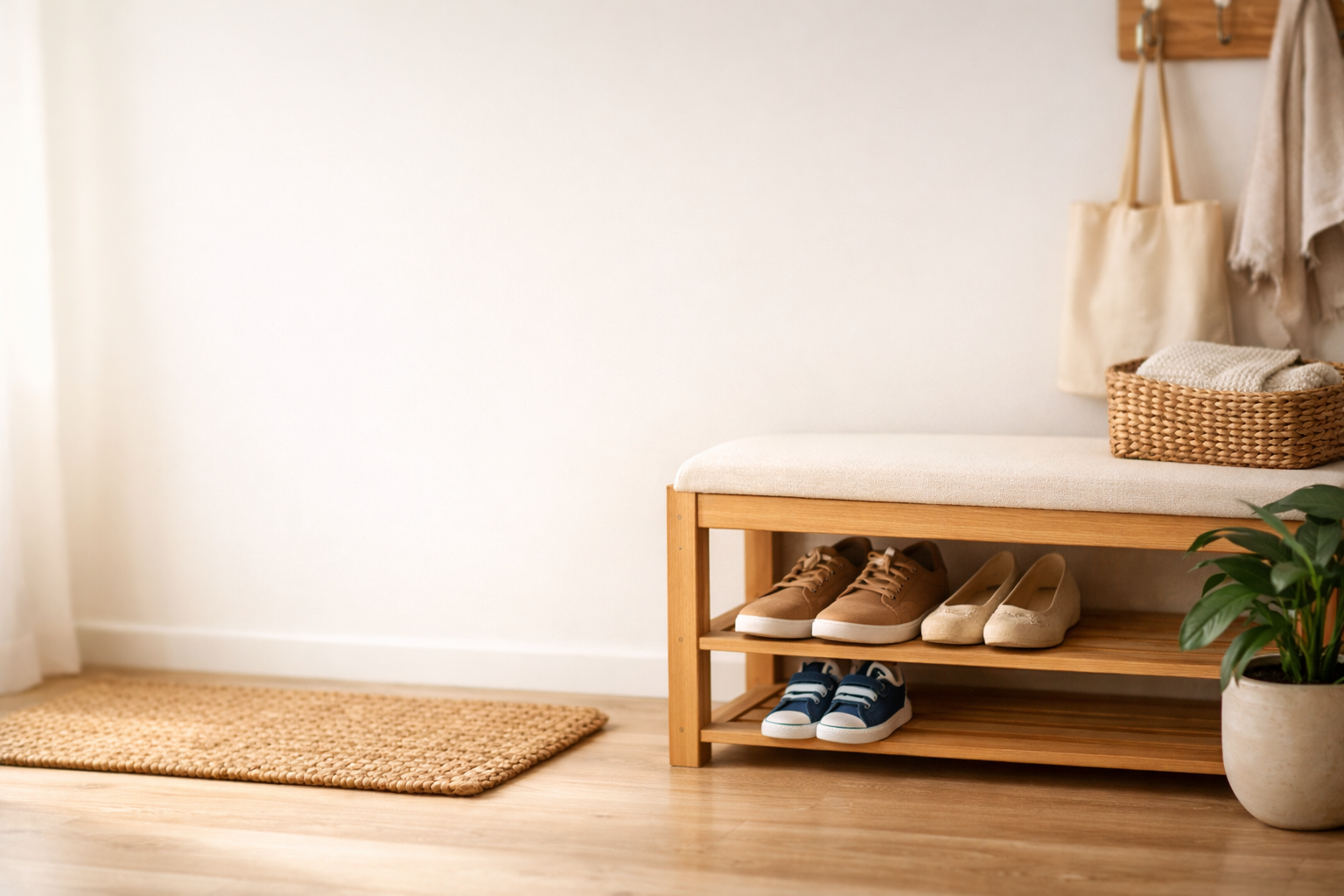
The shoe pile usually forms where the system asks too many steps of a tired family. A shoe-free request is easier when the doorway already holds a place to wipe, a place to drip, a place to sit, and a hook a child can reach.
This is a landing-zone guide, not a purity test. A shoe-free habit can keep ordinary outdoor dirt closer to the door. It does not replace cleaning, and it does not replace lead inspection or other exposure work when those are needed.
Short answer
If the floor is where children sit, snack, and play, outdoor grit has a short path onto hands. Stop outdoor shoes at the threshold, then let the doorway do the reminding.
A working landing zone does five ordinary jobs:
- Scrape and catch dirt before it crosses the room.
- Hold wet or muddy pairs so they are not parked on the floorboards.
- Give everyday shoes a home that is easier than the pile.
- Offer a stable seat for people who should not hop on one foot.
- Give bags and coats a hook so shoes are not the only thing dumped at the door.
Measure the landing first. Then use the supporting guides when one piece is the hard part: small-entryway shoe storage, mats and boot trays, and guest-friendly shoe-free habits.
The basic system
Measure before you buy anything. You need the width of the landing, the depth a door can spare, and the clearance under the door.
Outside: a scraping mat that can get wet and be shaken or hosed.
Inside, first step: an absorbent mat that the door can clear. The researched Waterhog mat lists a 3/8-inch thickness; if your door rubs, the mat bunches and people step around it.
Inside, wet pairs: a raised-edge tray. A tray is not a mat. It holds water. The official BAGGMUCK page does not identify the tray as a standing or nonslip surface, so keep it outside the standing path and check that its placement is stable on your floor.
Storage: only as much as the household will actually use. Everyday pairs belong where a child can reach them. Off-season pairs can leave the doorway.
Seat: a bench, stool, or other stable seat. Hopping on one foot is how the pile returns.
Hooks: one rail or a few hooks, with at least one at child height. The shoe rule fails when jackets still have nowhere to go.
A basket can stand in for a rack in a very small entry. It is harder to keep pairs upright and harder to dry wet shoes. Use it for dry everyday shoes, not muddy boots.
Adapting the system for children
Children follow the path of least resistance. If the “right” place is behind a closed door, the shoes will land in the walkway.
- Put child pairs on the lowest open shelf or in a low basket.
- Keep the tray for wet recess shoes, not for every dry pair.
- Mount one hook where a child can hang a backpack without help.
- Use a short, ordinary sentence: “Shoes stay here. Thanks.”
- Expect the system to be messy after school. Reset it once, not all afternoon.
A shoe-free home with kids is a traffic pattern. It is not a character test.
Guests, and people who need their shoes
If someone uses supportive footwear, orthotics, a cane, or has pain or balance trouble, keep the shoes on and clean the floor later. Offer the exception in the first sentence so a guest does not have to explain a medical detail in the doorway. The guest guide has the request, the seat, and the extras.
Small-space versions
A narrow hall needs fewer pieces, not a matching set: one interior mat, a tray that fits the landing (IKEA also lists an 18-inch BAGGMUCK if 28 inches is too long), wall hooks, and everyday pairs only. If storage is the squeeze, start with the small-entryway storage guide.
What this habit can and cannot do
EPA and CDC household pages include wiping or removing shoes and placing mats inside and outside entryways among steps that can reduce tracking lead-contaminated soil or dust indoors. Those tips sit beside paint repair, handwashing, and testing. A doorway habit does not inspect soil, fix deteriorating paint, or replace a clinician.
A 2006 pilot study measured soil moving indoors on footwear: one trip stayed fairly local, repeated trips spread it, and ordinary cleaning did not pick up all of it. A 2016 review found microbes on shoe soles in health-care, community, and food-work settings, and no consistently effective way to disinfect those soles. Together they support a small claim—shoes move outdoor dirt inside—not a healthy or sterile house.
Keep the job ordinary: less grit at the door, plus a calmer place to take shoes off. Clean the floor anyway.
Two researched examples
The mat and tray guide has the measurements and care details. These links are public-spec examples, not household tests.
L.L.Bean Washable Waterhog doormat at L.L.Bean · ResearchedSkip it if the door cannot clear the listed 3/8-inch thickness, or if you cannot wash a bulky mat.
IKEA BAGGMUCK shoe tray at IKEA · ResearchedSkip it if you need a standing or nonslip surface, or if you cannot keep the tray outside the walking path. A rimmed bin lid can stand in.
A short maintenance routine
Daily: nudge pairs back onto the rack or tray. Shake or vacuum the interior mat if it looks loaded.
After wet weather: empty the tray, wipe it, and let wet shoes dry with space around them. Closed cabinets are a poor place for soaked boots.
Weekly: take the interior mat out, clean under it, and do a normal floor clean in the first six feet of the house. The reset is ordinary cleaning, not a special product.
Seasonally: send unused pairs out of the landing zone. A doorway that stores every shoe in the house will stop being a doorway.
Related guides
- Small-entryway shoe storage — open rack, closed cabinet, basket, or bench
- Entryway mats and boot trays — scrape, absorb, and contain water
- A shoe-free home that still welcomes guests — the request, the exceptions, the seat
Sources
- U.S. EPA, Protect Your Family from Sources of Lead — wipe or remove shoes; place dust mats inside and outside entryways
- U.S. EPA, Lead in Soil — doormats at every entry and shoes off to reduce tracking contaminated soil
- CDC, About Lead in Soil — take shoes off when entering; soil can come in on shoes, clothes, or pets
- CDC, How to Prevent Lead Poisoning in Children — remove shoes to limit spreading lead-contaminated dust
- Hunt, Johnson, and Griffith, “Mass transfer of soil indoors by track-in on footwear,” Science of the Total Environment (2006): PubMed
- Rashid, VonVille, Hasan, and Garey, “Shoe soles as a potential vector for pathogen transmission: a systematic review,” Journal of Applied Microbiology (2016): DOI