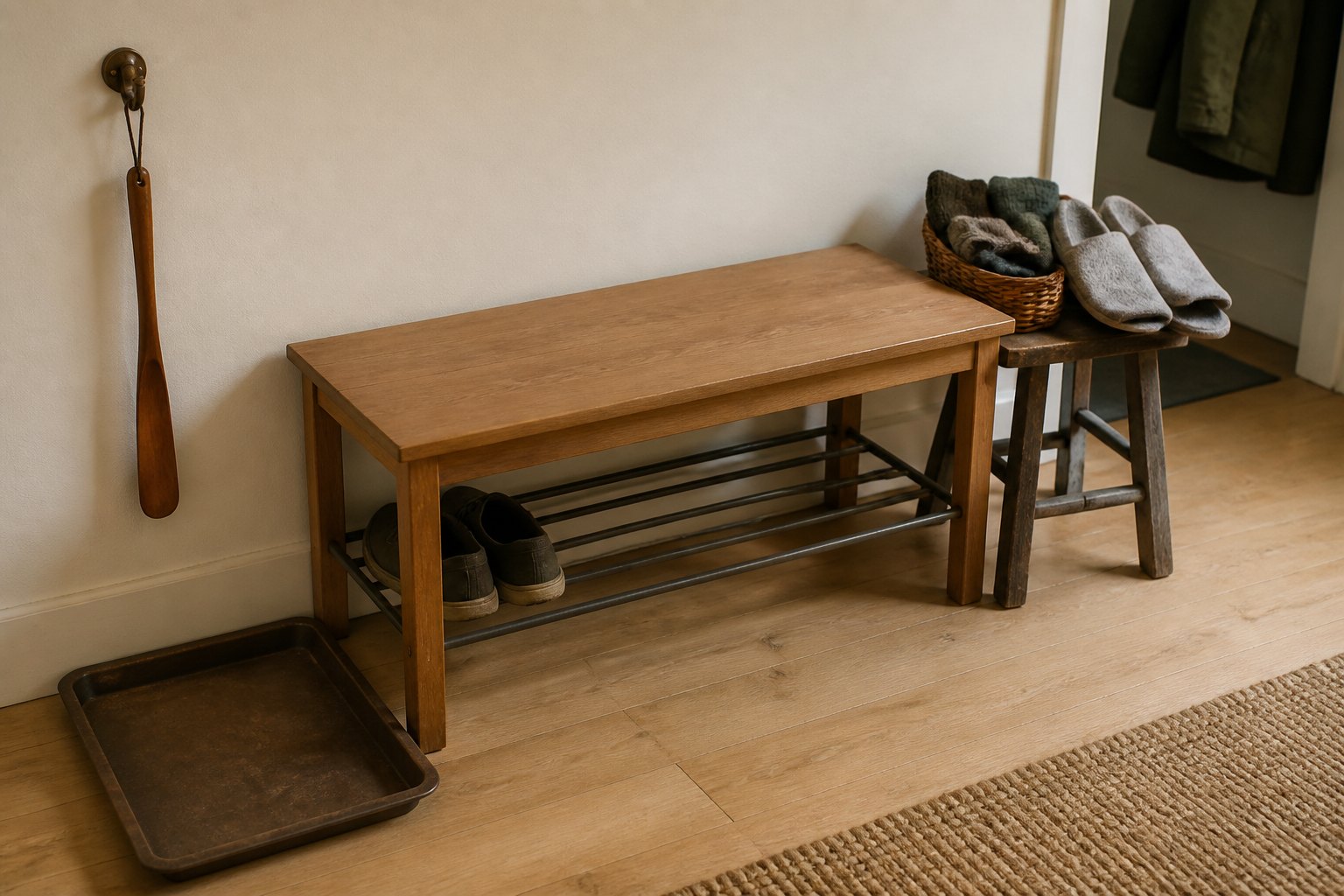
A shoe-free request goes badly when the house is ready with a rule and not ready with a seat.
This guide is for making the request ordinary: a short sentence, a visible place for shoes, and a clear exception for anyone who is safer leaving supportive footwear on. It is not medical advice. Generic slippers are not a stand-in for shoes a guest already knows they can walk in.
The wider family system lives in the shoe-free landing-zone guide. Here the reader is the person at the door.
Short answer
Say the habit once, like a fact. Point to the shoes’ place, the seat, and the extras. If a guest needs their own shoes for balance, pain, orthotics, or any mobility reason, the answer is yes. Clean the floor after they leave if you need to.
Dignity and safety outrank a consistent-looking entryway.
A short, friendly request
Skip the speech about germs. Skip the apology that makes everyone uncomfortable. One line is enough:
- “We’re shoe-free because the kids play on the floor. There’s a seat and slippers if you want them.”
- “Outdoor shoes stay here. Indoor pairs are welcome if that’s easier.”
- “Shoes off is our house habit—unless you need yours on.”
The last clause matters. If you only say the rule, people who need their shoes have to confess a medical detail in a doorway. If you offer the exception up front, they can keep their footing and their privacy.
Text the same line before a first visit if the guest has not been over. Surprise is what makes the request feel like a test.
A visible place for shoes
Guests will not hunt for a hidden rack. They will add to the pile that is already in the walkway.
Put guest shoes:
- on an open shelf or in a tray they can see from the door
- not behind a closed cabinet they have to figure out
- not in a room they have not been invited into
A small open zone labeled only by its obviousness—empty tray, empty shelf—does more than a sign. If your everyday storage is a closed cabinet, keep one open surface for visitors. The storage guide can help you split “family pairs” from “guest pairs” without adding another tall unit.
Washable extras, not a costume change
Offer, do not prescribe.
- Clean socks in a few adult sizes
- Washable slippers, also in a few sizes, washed between uses
- A pair of indoor-only slip-ons a regular visitor already prefers
Wash guest textiles the way you wash other shared linens. That is courtesy, not a health claim.
Skip cheap one-size slippers if they have no back, a slick sole, or a size that will slop off. A guest with any balance concern is safer in the shoes they arrived in than in loose foam.
If you cannot keep a slipper basket, clean socks are enough. Bare feet are not required.
A bench or other stable seat
Taking shoes off while standing is a balance task. Some people should not do it in a strange doorway.
A stable seat with a firm face, sitting where a person can reach their feet and still hold the door frame if they want, is the useful piece. Arms help some people and get in the way of others. A padded dining chair dragged over for a visit is an honest solution.
IKEA’s NIPÅSEN bench is one researched example of a hallway seat with a little shoe storage underneath: about 31 by 14 by 20 1/2 inches, a stretched-metal shelf for about four pairs, and a manufacturer seat test of 220.5 pounds. The fiberboard seat has no arms and is not a mobility aid. The listed load is a product test, not a clinical rating.
IKEA NIPÅSEN bench with shoe storage at IKEA · ResearchedSkip it if someone in your regular circle needs a higher seat, a wider transfer surface, or arms, or if 220.5 pounds is not enough margin for the people who will sit. Use a chair you already trust instead.
Place the seat beside a tray, not on it. The official BAGGMUCK page does not identify the tray as a standing or nonslip surface; keep it outside the standing path and check that its placement is stable.
A long-handled shoe horn
A long-handled shoe horn can help someone put indoor shoes or their own shoes back on without a deep bend. Hardware stores and shoe brands sell many versions. This guide does not link a specific model; the official pages checked during research were sold out or otherwise unstable. If you keep one, hang it where a guest can see it. Do not insist anyone use it. A shoe horn does not make an unsafe slipper safe, and it does not replace the shoes a guest knows how to walk in.
Mobility, orthotics, and foot pain
Let the guest decide. You are not there to evaluate their gait.
Reasons a person may keep outdoor shoes on, or switch only to their own indoor pair:
- balance or fall risk
- need for ankle support or a prescribed orthotic
- recent injury, surgery, or foot pain
- sensory needs
- a device that interfaces with a particular shoe
Do not offer to “just slip those off.” Do not block the only chair with a pile of family sneakers. Do not treat the exception as a favor you are granting.
If a support person or aide is with the guest, follow their lead on what that person needs at the door.
When an exception is the right ending
If shoes stay on, you still have options that do not involve a scene:
- Ask whether they would like to wipe the soles on the mat. Accept no.
- Keep the visit on easier-to-clean floors if that is already how your house works.
- After they leave, do a normal sweep or damp mop of the path they used.
That last step is ordinary housekeeping. It is not a moral scorecard, and it is not a reason to mention lead or germs to a guest who needed their shoes.
Who should skip a hard rule
Skip a rigid shoe-free rule when you regularly host people who cannot change shoes safely, when the landing has no seat, or when you are unwilling to clean the floor after an exception. In those houses, a strong mat and a tray for your household, plus a gentle offer for guests, is enough.
If children are the reason you care about the floor, you can still keep family shoes at the door and let guests be guests. The habit can be household-first without being unkind.
Maintenance after company
Wash the slipper basket contents. Wipe the guest tray. Put the shoe horn back on its hook. Return the extra chair if you borrowed one.
Then look at the landing the way a first-time visitor would. If the only empty hook is behind a coat pile, the next guest will not use it.
Related guides
- A shoe-free entryway with kids — why the landing zone exists and how the pieces fit
- Small-entryway shoe storage — keeping a visible guest shelf when family storage is closed
- Entryway mats and boot trays — containment when shoes stay on