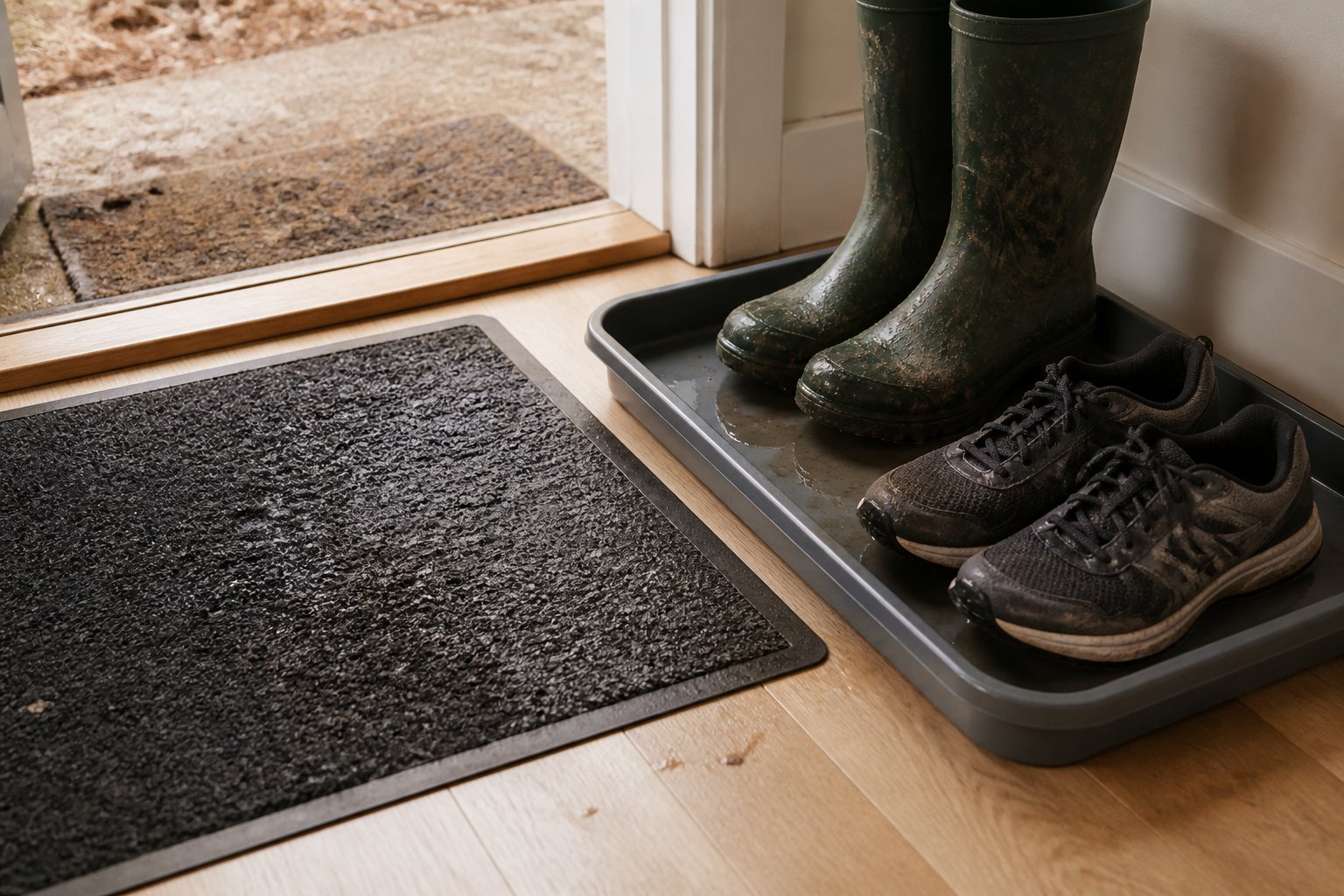
A mat cannot promise a clean house. It can catch the first pass of grit and water so the rest of the floor is not doing that job alone.
This guide is about containment at the threshold: what each layer is for, how to measure the door, and how to clean the setup after wet weather. It does not claim that a mat or tray prevents illness, removes lead, or replaces mopping. For the wider shoe-free system, start with the landing-zone guide.
Short answer
Use three different objects if you have the room, and two if you do not.
- Outside: a scraping surface that can live with weather.
- Inside: an absorbent mat the door can actually clear.
- Under wet pairs: a raised-edge tray that holds water instead of wicking it into the floor.
If the landing is tiny, keep the interior mat and the tray. The outdoor scraper can be a coarse mat you already own. Storage still matters—wet shoes left in a closed cabinet stay wet—but that choice lives in the small-entryway storage guide.
What each layer does
Exterior scraping mat. Coarse fibers or an open grid knock off mud, leaves, and slush before someone crosses the sill. It will get dirty. That is the point. It should be something you can shake, hose, or sweep.
Interior absorbent mat. This is the first indoor step. It takes the water that scraping missed. A raised border helps keep that water on the mat instead of on the finish around it. Thickness matters more than pattern. If the door catches the mat, people will kick it aside.
Raised-edge tray. A tray is a shallow tub. It is for pairs that are still wet, salty, or muddy. It is not a standing platform and it is not a disinfectant. Wipe it out. Do not ask anyone to balance on it while they take shoes off.
These layers do not cancel the need to clean. Repeated trips spread soil; the mat and tray just keep more of it in one place.
Door-clearance measurements
Measure before you order a mat you cannot return easily.
- Close the door and measure the gap from the floor to the bottom of the door at the tightest point.
- Subtract a little for a warped threshold, a rug pad, or winter grit under the mat.
- Compare that number to the mat’s listed thickness. The researched Waterhog mat lists 3/8 inch.
- Open the door through its full swing. The mat cannot bunch against the stop or slide under the door.
- For a tray, tape the length and width on the floor. Leave standing room beside it. A 14-inch-deep tray in an 18-inch landing leaves almost no place to put a foot.
If the door barely clears 3/8 inch, choose a thinner interior mat and let the tray do the water-holding. If the door sweeps inward across the only floor you have, put the tray on the hinge side and keep the mat as a runner that the door can pass.
Cleaning and drying
A containment system that you cannot clean becomes a dirt reservoir.
- Shake or hose the exterior mat; let it dry before it freezes into a brick.
- Vacuum or sweep the interior mat. If the manufacturer says a size is machine-washable, wash it alone and confirm your machine can actually turn it.
- Wipe a tray with a damp cloth and a milder cleaner you already trust on floors. Dry it. Standing water in a tray is still standing water.
- Give wet shoes air. Pull out insoles if you use that habit. Do not park soaked boots in a closed cabinet overnight.
- Clean the floor under the mat. The hidden rectangle is where the smell starts.
None of this is disinfection. If you need a disinfecting product for a specific surface, use a labeled product as directed. A tray is not that product.
Wet weather and seasons
Rain, slush, and spring mud are when the tray earns its footprint. In dry months the tray can tuck under a bench or leave the landing.
Salt and sand are harder than mud. They stay abrasive after the water dries. Sweep them off the mat instead of grinding them in with wet shoes the next morning.
In snowy places, keep a second pair of “porch shoes” or yard boots outside if you have a covered spot. The indoor tray then only handles the pairs that must come in.
Summer can be simpler: one scraper, one small interior mat, and no tray until the next wet week.
Small-entry alternatives
- One interior mat that is shorter than the door swing, plus a tray that lives in a nearby closet on dry days.
- A towel on top of a tray for a weekend of mud, then wash the towel.
- The smaller 18-by-14-inch BAGGMUCK size if a 28-inch tray blocks the walkway.
- No exterior mat if you have no stoop; be more strict about the interior tray instead.
A folded towel is an honest substitute while you measure. It is also easy to throw in the wash, which is the whole point of this system.
Main limitations
- Mats do not remove contaminants from a house. They reduce how far the first load of grit travels.
- A raised border can trip someone if it sits in the walking line or curls.
- Rubber backings can stain some floors or trap moisture on wood. Check your floor finish and dry underneath.
- The official BAGGMUCK page does not identify the tray as a standing or nonslip surface. Keep it outside the standing path and verify that its placement is stable on your floor.
- None of this replaces cleaning, handwashing after outdoor play, or professional help when soil contamination is a real concern.
EPA and CDC both mention doormats and shoe removal among household steps for reducing tracked-in soil and dust. That is the ceiling of the health claim in this article.
Two researched examples
These examples follow the official product pages. They are not household tests, not a ranked pair, and not affiliate links.
Interior or dual-use mat. L.L.Bean’s Washable Waterhog, Honeycomb, is listed for indoor and outdoor use, with a raised border, rubber backing, and 3/8-inch thickness. Small is 20 by 30 inches; medium is 23 by 35; large is 35 by 59. The page says small and medium can be machine-washed; the large size needs a front-loading commercial machine. The useful job is scrape-plus-contain on one surface, if the door clears 3/8 inch.
L.L.Bean Washable Waterhog doormat at L.L.Bean · ResearchedSkip it if your door cannot clear 3/8 inch, if you need a very thin mat, or if you cannot wash a bulky piece. A thinner washable rug plus a separate tray splits the jobs.
Raised-edge tray. IKEA’s BAGGMUCK 28-by-14-inch tray is a polypropylene indoor/outdoor tray with a high edge. Care is a damp cloth and mild cleaner. IKEA notes it can sit under a rack or cabinet and be pulled out to wipe. The official page does not identify it as a standing or nonslip surface.
IKEA BAGGMUCK shoe tray at IKEA · ResearchedSkip it if you need a standing or nonslip surface, or cannot spare 14 inches of depth. A rimmed metal baking sheet or a plastic bin lid is the category substitute.
Who should skip or adapt this system
Skip a thick interior mat if anyone uses a walker, wheelchair, or cane that could catch a raised border. A flush, low-profile mat—or no interior mat and a tray to the side—is safer than a proud edge in the path.
Skip a tray-as-doormat setup if children will treat it as a step.
If someone must keep supportive shoes on, let them. Clean the path they used. The guest and accessibility guide is the place for that exception, not a stricter mat.
Maintenance
After each wet day: empty the tray, wipe it, shake the exterior mat, and give the interior mat a vacuum or a wash if it is loaded.
Once a week: lift the interior mat and clean the floor under it.
Once a season: re-measure the door. Thresholds collect grit. A mat that cleared in August may rub in January.
Related guides
- A shoe-free entryway with kids — mat, tray, storage, seat, and hooks as one system
- Small-entryway shoe storage — where dry pairs go after the tray
- A shoe-free home that still welcomes guests — when shoes stay on, clean the path later
Sources
- U.S. EPA, Protect Your Family from Sources of Lead
- U.S. EPA, Lead in Soil
- CDC, About Lead in Soil
- Hunt, Johnson, and Griffith (2006), track-in of soil on footwear: PubMed