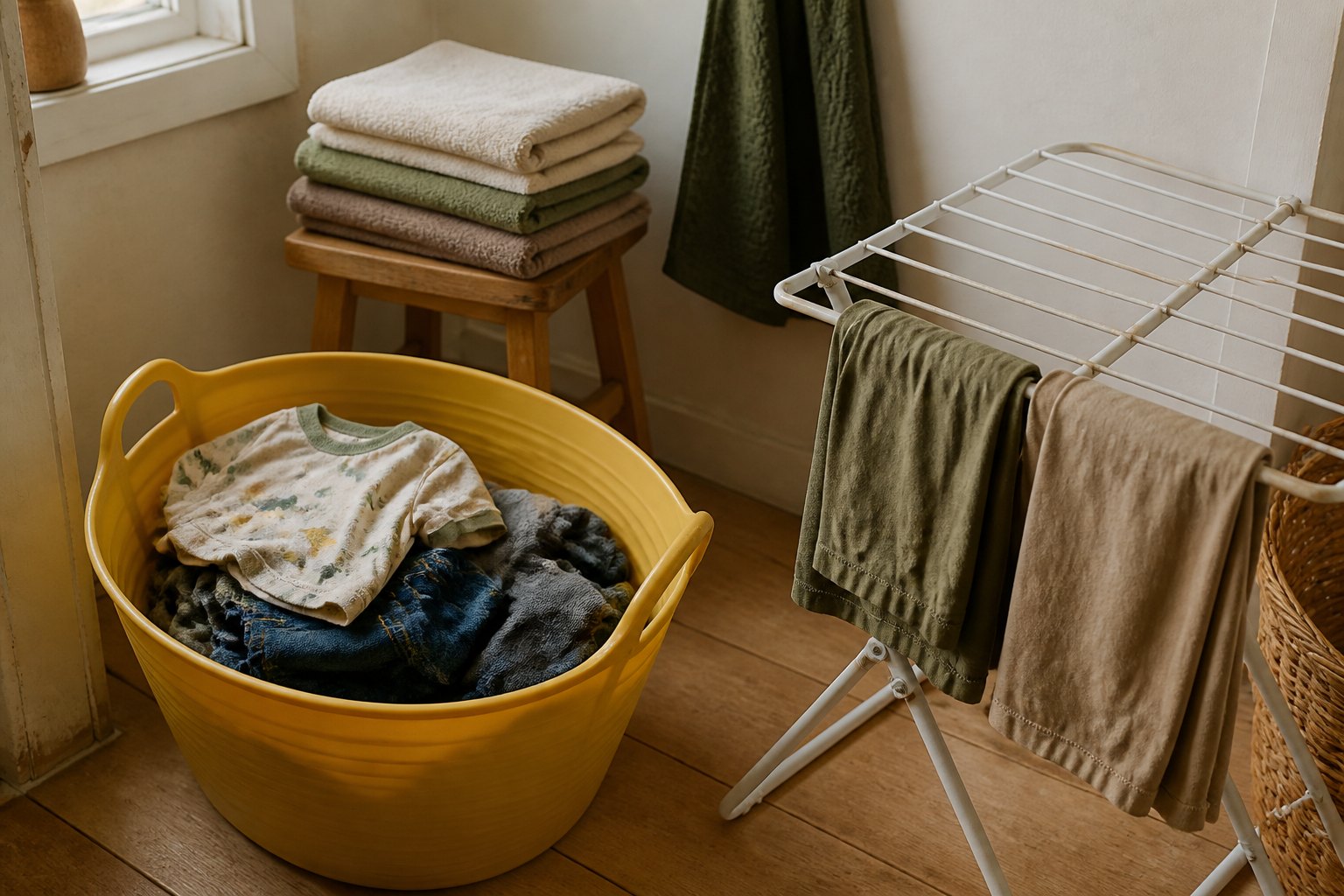
Dirty clothes become a second floor covering when the house asks too many steps between “take it off” and “it has a place.” A small laundry room does not fix that. A short path does.
This is a household-system guide, not a detergent review and not a promise that air-drying will save a utility bill. The supporting guides cover the hard pieces: indoor drying racks, hampers and collection, and folding and putting away.
Short answer
Give laundry five ordinary jobs, then stop adding furniture.
- Collect dirty clothes where they actually come off—not two rooms away.
- Carry a load that the person doing laundry can lift.
- Wash on the machine you already have, in loads you can finish.
- Dry without blocking the only walkway, and without trapping extra moisture in a closed room.
- Fold and put away the same day the load comes off the rack or out of the dryer, even if the fold is imperfect.
Measure the spare rectangle first: beside the bed, in the bathroom, in the hall, and in front of the washer. Then choose the smallest container and the smallest drying format that fit those rectangles.
The basic path
One collection point per person or per bedroom beats one heroic hamper by the washer. If the hamper is downstairs and the clothes come off upstairs, the floor wins.
A carry container is not the same as a hamper. A standing bag can live in a closet. A flexible basket is for the trip to the machine and for wet clothes coming back out. If you only have one object, use it for carrying and keep dirty clothes in a pillowcase or a tote you already own until wash day.
Wash what you can put away. A machine that holds more than the house can dry or fold just makes a clean pile on the sofa.
Drying needs air and a footprint. Air-drying skips a dryer cycle; it also leaves water in the room. If windows fog or pipes sweat, open a window, run a bath fan, or move the rack. Humidity numbers and when to skip indoor drying live in the drying-rack guide.
Folding is part of laundry. A clean pile on a chair is a delay, not a finish. The folding guide is the last step of this system.
Children
Children will use the container they can reach and will not use the one behind a closed adult hamper.
- Put their collection point in their room or by their dresser.
- Keep the carry weight honest. A researched 6-gallon basket lists a 9-pound maximum load; that is a limit, not a character test.
- Give them one short sentence: “Dirty clothes go here.” Reset the overflow once, not all evening.
- Do not make a child carry a full family load down stairs. An adult carries the heavy tote; a child can bring their own small basket.
Small-space versions
A studio or a hall washer needs fewer objects:
- one small collection basket in the living area
- one compact drying rack that folds and stores beside the machine
- a table or bed already in the room for folding
Skip a matching set. Two extra hampers in a galley kitchen are just more things to walk around.
If the washer is in a shared hallway or a laundromat, the collection bag has to be something you can carry with one hand free for a door or a rail. That is a hamper-format decision, not a reason to buy a rolling cabinet.
Two researched examples
The hamper guide and drying-rack guide have the measurements and care details. These links are public-spec examples, not household tests. A pillowcase and a shower rod can cover the same jobs.
IKEA TORKIS flexible laundry basket at IKEA · ResearchedSkip it if you need a closed hamper, or if a full 9-gallon tote is more than the person carrying it can manage. A tote you already own is the substitute.
IKEA JÄLL drying rack at IKEA · ResearchedSkip it if you regularly need a full family load on the rack at once. The drying guide has the larger winged rack and the hanging clip dryer.
Wood, willow, and secondhand
Use these when the object can live in the room as furniture, when a secondhand basket is what you can get this week, or when you will actually keep the listed care. Willow can cover the same carry job as the flexible tote above. A poplar floor rack is a large drying format—closer to a winged steel rack than to the compact one. Willow should be wiped dry, not soaked. A wooden rack still needs a real footprint when it is open.
IKEA TOLKNING willow carry basket at IKEA · ResearchedSkip it if 13 pounds is less than you carry, or if you need a standing sorter. The hamper guide has the measurements and the taller two-compartment willow basket.
Lehman's large wooden drying rack at Lehman's · ResearchedSkip it if you cannot spare a long open rectangle, or if the rack has to travel up a narrow stair every wash day. The drying guide has the folded size and the shipping limit.
A thrifted crate or woven hamper can fill the same job if the handles are sound and the weave is not already failing. Measure the doorway and the landing spot before you buy it. Skip a musty basket, a cracked frame, or a lidded hamper you plan to use as the only home for wet towels.
What this system cannot do
It does not replace a working washer. It does not disinfect clothes. It does not keep a basement from growing mold if the room is already damp. Moisture control is a room problem, not a special laundry product—see the drying-rack guide.
If someone in the household cannot lift, stand at a machine, or reach a rack, adapt the path: a lower basket, a seated fold, a smaller load, help from another person. The system should shrink, not shame.
Related guides
- Indoor drying racks for small spaces— compact, winged, or hanging
- Family laundry hampers— basket, bag, or narrow sorter
- Folding and putting away in a small home— so the clean pile does not become furniture
Sources
- U.S. EPA, What are the main ways to control moisture in your home?— drying clothes indoors can add household moisture